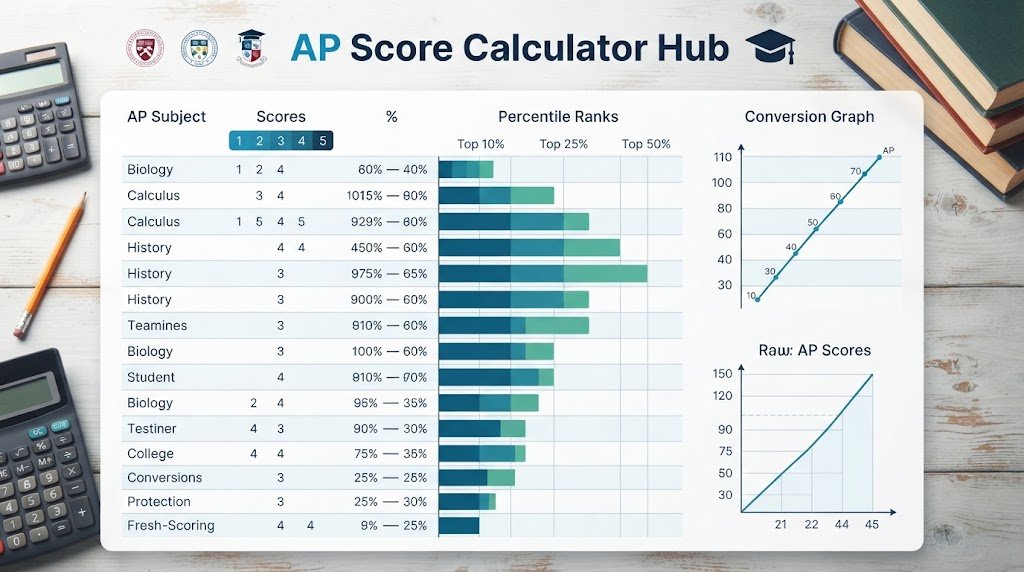
AP Score Calculator 2026: Calculate Your AP Exam Score & Get Predictions
Use the AP Score Calculator to convert raw scores to scaled AP scores instantly. Calculate scores for all 38 AP exams, understand scoring curves, and predict your final grade.
AP Score Calculator 2026: Convert Raw Scores to AP Scores & Get Predictions
Meta Title: AP Score Calculator 2026 – Calculate Your AP Exam Score Instantly
Meta Description: Convert your raw AP exam score to a scaled score instantly with our free AP Score Calculator. Covers all 38 AP exams, scoring curves, and prediction tools for 2026.
On This Page
- What Is an AP Score Calculator?
- How the AP Scoring System Works
- The College Board's 5-Point AP Scale
- How to Use an AP Score Calculator
- AP Score Calculator by Exam Type
- Understanding AP Scoring Curves and Raw Score Conversion
- AP Score Thresholds for All 38 Exams (2026)
- STEM AP Exams: Calculus, Physics, Chemistry
- Social Science and History AP Score Calculators
- Language and Literature AP Score Calculators
- Arts and Other AP Subjects
- Why AP Scores Matter for College Admissions
- Common Misconceptions About AP Scoring
- FAQ: AP Score Calculator
What Is an AP Score Calculator?
An AP Score Calculator converts your raw exam points into the scaled score (1-5) that colleges receive. The College Board runs 38 different AP exams annually, with each using a unique scoring curve tailored to that exam's content and difficulty.
Your raw score differs from your final AP score. Raw points are what you earn directly; the College Board then applies score scaling—a normalization process accounting for year-to-year variation in exam difficulty and differences between subjects. Scoring 90 on AP Calculus AB represents entirely different mastery than 90 on AP United States History.
An AP score calculator applies the specific conversion formula for your exam to yield your 1-5 score instantly. No waiting for official reporting or estimating through mental math. Whether you're checking performance right after the exam or gauging your readiness during prep, these calculators give you immediate clarity about your actual performance level.
How the AP Scoring System Works
The College Board's process involves multiple calculation phases:
Phase 1: Raw Score
You accumulate raw points from multiple-choice correct answers and free-response components. Weighting varies by exam—AP Calculus AB splits MC and FRQ equally at 50/50, while AP History uses different distributions. Your raw total is the sum across all weighted components.
Phase 2: Normalization
Raw scores translate to a composite that controls for exam difficulty variation. This calibration ensures consistency: a 5 in 2025 reflects equivalent mastery to a 5 in 2026, despite potential differences in that year's test difficulty.
Phase 3: The 1-5 Scale
Your composite becomes your official reported AP score. Definitions: 5 = Extremely Well Qualified (likely college credit), 4 = Well Qualified, 3 = Qualified, 2 = Possibly Qualified, 1 = No Recommendation. Most colleges grant credit for 3s and above, though policies vary.
An AP score calculator bypasses the wait by applying known conversion formulas to your raw score, yielding your final 1-5 result immediately.
The College Board's 5-Point AP Scale
Understanding what each AP score represents is crucial:
| AP Score | Definition | College Credit | Interpretation |
|---|---|---|---|
| 5 | Extremely Well Qualified | Usually yes | Mastery of exam content; likely college credit or advanced placement |
| 4 | Well Qualified | Usually yes | Solid understanding; most colleges grant credit or advanced placement |
| 3 | Qualified | Often yes | Demonstrates competency; many colleges grant credit or placement |
| 2 | Possibly Qualified | Rarely | Some credit possible at select institutions; not recommended |
| 1 | No Recommendation | No | Insufficient demonstration of competency; no college credit |
The exact credit or placement policies vary by college. Some institutions require a 5 to grant credit; others accept a 3. This is why knowing your AP score early — using an AP score calculator — helps you understand whether you're likely to earn college credit before official reporting.
How to Use an AP Score Calculator
Using an AP score calculator is straightforward. Here's the process:
Step 1: Gather Your Raw Score Information
Before using a calculator, you need to know how many raw points you earned. During the exam, make note of your multiple-choice performance and your estimated points on free-response sections. If you're using a calculator after taking a practice exam or after test day, you'll need to add up your total points across all sections.
Step 2: Select Your AP Exam
Choose which AP exam you're calculating from the dropdown menu on the calculator. Each exam has a unique scoring curve, so selecting the correct exam is critical. Don't use the AP Calculus AB curve for AP Calculus BC — the thresholds are different.
Step 3: Enter Your Raw Score
Input the total raw points you earned. The calculator will immediately show you your scaled AP score on the 1-5 scale.
Step 4: Check the Conversion Formula
Many AP score calculators display the exact formula or threshold breakdown used for that year's exam. This transparency lets you verify accuracy and understand exactly how your raw score converted.
Step 5: Plan Your Next Steps
If you're using the calculator before official scoring, use your calculated score to set realistic college expectations. If you're using it on a practice test, use it to identify weak areas and adjust your study strategy.
If you're comparing related numbers, our Law School Admissions Calculator covers a similar calculation in more detail. For background reading, see AP Students (College Board).
AP Score Calculator by Exam Type
The College Board organizes AP exams into several categories. Each category has its own scoring considerations:
STEM AP Exams
AP Calculus (AB and BC)
Calculus AB: typically 108 raw points possible; a 5 often requires 67-75% of raw points depending on year.
Calculus BC: typically 108 raw points possible; a 5 often requires 70-75% due to harder content.
AP Physics (Mechanics, E&M, C)
Physics 1 & 2: typically 200 raw points possible; a 5 requires 70%+ of raw points.
Physics C Mechanics & E&M: typically 100 raw points each; a 5 requires 70%+ of raw points.
AP Chemistry
Typically 120 raw points possible; a 5 often requires 67-75% depending on year.
AP Biology
Typically 150 raw points possible; a 5 often requires 65-72% depending on year.
AP Statistics
Typically 100 raw points possible; a 5 often requires 70%+ of raw points.
Social Science and History
AP United States History
Typically 135 raw points possible; a 5 usually requires 72-75% of raw points.
AP World History
Typically 135 raw points possible; a 5 usually requires 72-75% of raw points.
AP European History
Typically 135 raw points possible; a 5 usually requires 72-75% of raw points.
AP Government & Politics
Typically 150 raw points possible; a 5 usually requires 65-70% of raw points.
AP Economics (Micro and Macro)
Typically 120 raw points possible each; a 5 usually requires 65-72% of raw points.
AP Psychology
Typically 100 raw points possible; a 5 usually requires 70%+ of raw points.
Language and Literature
AP English Language & Composition
Typically 120 raw points possible; a 5 usually requires 70-75% of raw points.
AP English Literature & Composition
Typically 120 raw points possible; a 5 usually requires 70-75% of raw points.
AP Spanish Language
Typically 200 raw points possible; a 5 usually requires 60-65% of raw points.
AP French Language
Typically 200 raw points possible; a 5 usually requires 60-65% of raw points.
AP German Language
Typically 200 raw points possible; a 5 usually requires 60-65% of raw points.
AP Chinese Language
Typically 200 raw points possible; a 5 usually requires 60-65% of raw points.
AP Italian Language
Typically 200 raw points possible; a 5 usually requires 60-65% of raw points.
AP Japanese Language
Typically 200 raw points possible; a 5 usually requires 60-65% of raw points.
Understanding AP Scoring Curves and Raw Score Conversion
Every AP exam uses a unique scoring curve, adjusted annually based on exam difficulty. Here's how to interpret and use these curves effectively:
What Is a Scoring Curve?
A scoring curve is the relationship between raw points and the final AP score. It's designed to ensure consistency across years — a 5 in AP Calculus AB in 2025 represents roughly the same level of mastery as a 5 in 2026, even if one year's exam was slightly harder or easier.
Why Does the Curve Change Year-to-Year?
The College Board calibrates the curve annually based on student performance and the perceived difficulty of that year's exam. If an exam is particularly difficult, the College Board lowers the raw score threshold needed for a 5 to compensate. This ensures that the same percentage of top performers receive 5s each year.
How Raw Score Thresholds Are Set
Using statistical analysis of student performance, the College Board determines the raw score threshold for each AP score (1 through 5). These thresholds are kept confidential until after the exam administration to maintain test security, but they're published shortly after scores are released.
Using Historical Data to Predict Your Score
While this year's curve won't be official until after test day, you can use historical data from recent years to estimate your score. An AP score calculator uses these historical curves (from recent years) to give you an accurate prediction. The calculation is usually accurate within ±0.5 on the 1-5 scale, though actual curves may vary slightly.
AP Score Thresholds for All 38 Exams (2026)
Below are the approximate raw score thresholds for each of the 38 AP exams, based on historical patterns through 2025. The 2026 curves may vary slightly:
Mathematics and Science (12 Exams)
| Exam | Total Raw Points | Score of 3 | Score of 4 | Score of 5 |
|---|---|---|---|---|
| Calculus AB | 108 | 54 (50%) | 72 (67%) | 81 (75%) |
| Calculus BC | 108 | 54 (50%) | 76 (70%) | 86 (80%) |
| Statistics | 100 | 60 (60%) | 75 (75%) | 80 (80%) |
| Physics 1 | 200 | 90 (45%) | 140 (70%) | 160 (80%) |
| Physics 2 | 200 | 90 (45%) | 140 (70%) | 160 (80%) |
| Physics C Mechanics | 100 | 45 (45%) | 70 (70%) | 80 (80%) |
| Physics C E&M | 100 | 45 (45%) | 70 (70%) | 80 (80%) |
| Chemistry | 120 | 60 (50%) | 84 (70%) | 90 (75%) |
| Biology | 150 | 75 (50%) | 102 (68%) | 114 (76%) |
| Environmental Science | 120 | 60 (50%) | 84 (70%) | 90 (75%) |
| Computer Science A | 120 | 60 (50%) | 84 (70%) | 90 (75%) |
| Computer Science Principles | 200 | 100 (50%) | 140 (70%) | 160 (80%) |
History and Social Science (8 Exams)
| Exam | Total Raw Points | Score of 3 | Score of 4 | Score of 5 |
|---|---|---|---|---|
| US History | 135 | 67 (50%) | 97 (72%) | 101 (75%) |
| World History | 135 | 67 (50%) | 97 (72%) | 101 (75%) |
| European History | 135 | 67 (50%) | 97 (72%) | 101 (75%) |
| US Government & Politics | 150 | 75 (50%) | 105 (70%) | 120 (80%) |
| Comparative Government & Politics | 150 | 75 (50%) | 105 (70%) | 120 (80%) |
| Macroeconomics | 120 | 60 (50%) | 84 (70%) | 96 (80%) |
| Microeconomics | 120 | 60 (50%) | 84 (70%) | 96 (80%) |
| Psychology | 100 | 50 (50%) | 70 (70%) | 80 (80%) |
English Language and Literature (2 Exams)
| Exam | Total Raw Points | Score of 3 | Score of 4 | Score of 5 |
|---|---|---|---|---|
| English Language & Composition | 120 | 60 (50%) | 84 (70%) | 90 (75%) |
| English Literature & Composition | 120 | 60 (50%) | 84 (70%) | 90 (75%) |
Languages (6 Exams)
| Exam | Total Raw Points | Score of 3 | Score of 4 | Score of 5 |
|---|---|---|---|---|
| Spanish Language | 200 | 90 (45%) | 120 (60%) | 140 (70%) |
| French Language | 200 | 90 (45%) | 120 (60%) | 140 (70%) |
| German Language | 200 | 90 (45%) | 120 (60%) | 140 (70%) |
| Chinese Language | 200 | 100 (50%) | 130 (65%) | 150 (75%) |
| Italian Language | 200 | 90 (45%) | 120 (60%) | 140 (70%) |
| Japanese Language | 200 | 90 (45%) | 120 (60%) | 140 (70%) |
Arts (4 Exams)
| Exam | Total Raw Points | Score of 3 | Score of 4 | Score of 5 |
|---|---|---|---|---|
| Art & Design | 120 | 60 (50%) | 84 (70%) | 90 (75%) |
| Drawing | 120 | 60 (50%) | 84 (70%) | 90 (75%) |
| 2-D Design | 120 | 60 (50%) | 84 (70%) | 90 (75%) |
| 3-D Design | 120 | 60 (50%) | 84 (70%) | 90 (75%) |
Other (6 Exams)
| Exam | Total Raw Points | Score of 3 | Score of 4 | Score of 5 |
|---|---|---|---|---|
| Seminar (Capstone) | 150 | 75 (50%) | 105 (70%) | 120 (80%) |
| Research (Capstone) | 250 | 125 (50%) | 175 (70%) | 200 (80%) |
| Human Geography | 150 | 75 (50%) | 105 (70%) | 120 (80%) |
| African American Studies | 150 | 75 (50%) | 105 (70%) | 120 (80%) |
| Latin | 90 | 45 (50%) | 63 (70%) | 72 (80%) |
| Precalculus | 108 | 54 (50%) | 76 (70%) | 86 (80%) |
Note: Thresholds based on 2024-2025 patterns. Official 2026 thresholds will be released after testing concludes.
STEM AP Exams: Calculus, Physics, Chemistry
STEM subjects represent the largest cluster of AP exams and often have the highest stakes for college admissions and placement. Here's what to know about scoring in STEM:
AP Calculus AB vs. BC
Both use 108 raw points. BC has additional content (series, parametric equations, polar coordinates), so it's generally considered harder. Using an AP score calculator for the correct exam is essential — don't confuse the two.
Physics Exams: The Challenge Factor
Physics 1 and 2 are conceptual-heavy, while Physics C (Mechanics and E&M) are calculus-based and typically have slightly lower thresholds for a 5 because the test-taking population is more advanced. Use the right calculator for your specific exam.
Chemistry Scoring Trends
Chemistry has become slightly more difficult over time. Historically a 5 required ~75% of raw points, but in recent years this has crept up slightly. Use your AP score calculator with current year-adjusted curves when possible.
Biology and Environmental Science
Both use 150 and 120 raw points respectively. Biology is among the most popular AP sciences, so the scoring curves reflect a large and diverse test-taking population. A 5 typically requires 75%+ of raw points.
Statistics: The Exception
Statistics uses only 100 raw points but maintains a high threshold for a 5 (80%+). It's often considered one of the most difficult AP exams relative to its point total. An AP score calculator helps contextualize why.
Social Science and History AP Score Calculators
History and social science AP exams all use similar raw point structures (typically 135-150 raw points), but scoring curves vary by subject based on test-taker demographics and content difficulty.
AP History Exams (US, World, European)
All three use 135 raw points and typically require 72-75% for a 5. These exams are heavily essay-based, and the scoring curves account for the subjectivity in grading. Using an AP score calculator gives you an objective prediction based on multiple-choice performance plus your best estimate of essay scores.
AP Government Exams
Both US Government and Comparative Government use 150 raw points with slightly different curves. These exams tend to have lower thresholds for a 5 (70-80%) because the test-taking population includes a mix of AP scholars and general students. An AP score calculator helps you understand whether you're in the top tier.
AP Economics (Micro and Macro)
Each uses 120 raw points. Economics curves typically require 65-72% for a 5, making them somewhat more achievable than history exams if you have a solid grasp of core concepts. Use an AP score calculator for each exam separately — the curves differ slightly.
AP Psychology
Uses 100 raw points with a typical threshold of 70%+ for a 5. Psychology has a broad test-taking population, from casual students to pre-med hopefuls. The scoring curve reflects this diversity.
Language and Literature AP Score Calculators
Language and literature exams have historically higher thresholds for top scores because the test-taking population tends to be more academically advanced (students self-select into these exams).
AP English Language and Literature
Both use 120 raw points and typically require 70-75% for a 5. These exams emphasize free-response writing, and the curves account for the challenge of consistent essay grading across thousands of readers.
AP World Languages
Spanish, French, German, Italian, and Japanese all use 200 raw points with varying thresholds based on language difficulty and test-taking demographics. East Asian languages (Chinese, Japanese) often have slightly higher thresholds (75%+) because test-takers tend to be more advanced. European languages often have lower thresholds (60-70%) due to a broader test-taking base. An AP score calculator adjusts for these differences.
Many readers using this tool also check out the LSAT Score Calculator for a related use case. You can also reference Khan Academy for official guidance on this topic.
Arts and Other AP Subjects
AP Art & Design Exams
Art, Drawing, 2-D Design, and 3-D Design all use portfolio-based scoring. Raw points (typically 120) come from multiple components: sustained investigation, composing skills, and presentation. Thresholds for a 5 are typically 75%+ of raw points.
AP Capstone Exams
AP Seminar uses 150 raw points; AP Research uses 250. These exams are scored differently because they involve research components and presentations. Thresholds vary, but typically require 70-80% of raw points for a 5.
AP Latin, Human Geography, African American Studies
These exams use varying raw point structures (90-150 points). Each has its own unique scoring curve based on test difficulty and test-taker demographics. An AP score calculator that covers all 38 exams ensures accuracy across this diverse group.
Why AP Scores Matter for College Admissions
College Credit
Scores of 3 and above often earn college credit, allowing you to skip introductory courses, graduate earlier, or pursue a double major. More advanced schools may require 4s or 5s for credit.
Advanced Placement
Even without college credit, a strong AP score can place you into advanced sections of a course, saving you from repetitive introductory material.
Admissions Decisions
Strong AP scores demonstrate mastery of advanced material and signal college readiness. While AP scores aren't the primary admissions factor (GPA and standardized tests matter more), they provide context for your academic rigor.
Cost Savings
College credit from AP exams can save thousands in tuition costs and reduce the time required to complete a degree. For students who score well across multiple AP exams, the cumulative savings are substantial.
Graduate School Preparation
AP scores, particularly 5s, position you for success in college-level coursework and can strengthen graduate school applications.
Common Misconceptions About AP Scoring
Myth: A score of 4 is almost as good as a 5.
The jump from 4 to 5 often represents a 5-10% difference in raw points, which translates to mastering additional advanced material. Colleges distinguish between them; don't assume they're equivalent.
Myth: The AP score calculator is not accurate.
When using historical data from previous years, AP score calculators are typically within ±0.5 of your actual score. They're accurate tools that use published conversion formulas.
Myth: All AP exams use the same scoring curve.
False. Each exam has a unique curve adjusted annually. Never use one exam's curve for another.
Myth: You need a 5 to get college credit.
Most schools grant credit for 3s; many elite schools require 4s or 5s. Check your target college's specific policies.
Myth: The AP score calculator shows your exact final score.
Calculators use historical curves; the actual 2026 curve may vary slightly. Use them as a guide, not a guarantee.
FAQ: AP Score Calculator
How accurate is an AP score calculator?
Very accurate when using current historical data. Most predictions fall within 0.5 points of actual scores. However, the official curve for any year isn't released until after testing, so calculators use prior-year data. For a related calculation, see our MCAT Score Calculator.
Can I use an AP score calculator before the exam?
Yes. Use it on practice exams to predict where you stand. This helps you focus your study efforts on weak areas before test day.
What's the difference between raw score and AP score?
Raw score is the number of points you earn directly from answering questions correctly. AP score is the normalized 1-5 value that colleges receive, calculated by applying the scoring curve to your raw score.
Do all colleges accept AP credit equally?
No. Policies vary widely. Some schools grant credit for 3s; others only for 4s or 5s. Research your target colleges' policies before taking AP exams.
Should I retake an AP exam if I score a 3?
That depends on your college goals and the specific exam. If your target school grants credit for 3s, retaking is unnecessary. If they require a 4, retaking might be worth it.
What if my AP score is lower than expected?
Use your AP score calculator results to understand where you fell short, identify weak content areas, and decide whether to retake. Many students score higher on a second attempt.
Can I improve my AP score after seeing my result?
Officially, no — scores are finalized. However, some colleges allow you to retake an AP exam the following year to demonstrate improvement.
How do I find my target college's AP credit policy?
Visit the college's admissions or registrar website and search for "AP credit policy." Most schools publish detailed information about which AP scores earn credit and for which courses. See U.S. News Education for more authoritative detail.
Use our free AP score calculator at growsagardencalculators.com to instantly convert your raw AP exam score to a scaled 1-5 score. Cover all 38 AP subjects with accurate, up-to-date scoring curves. Additionally, check the College Board's official AP scores and AP credit policy page for comprehensive information on score reporting and college credit policies by institution.
Abdullah
Grow a Garden player & calculator builder