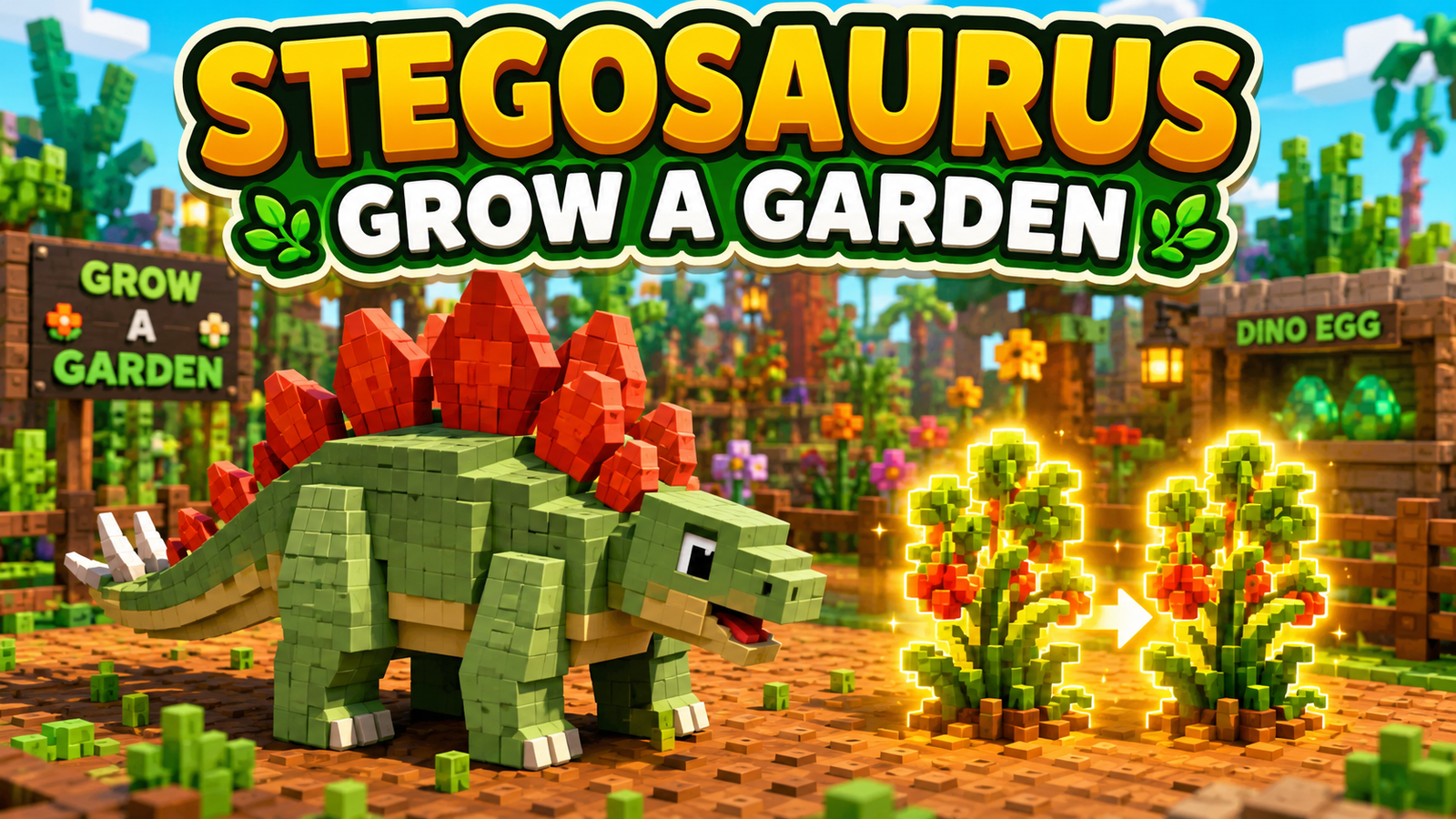
Stegosaurus Grow a Garden: Ability, How to Get One & Is It Worth It (2026)
Complete guide to the Stegosaurus pet in Grow a Garden — ability breakdown, duplication mechanics, how to get one, best crop pairings, weight scaling, and whether it's worth adding to your lineup.
The Stegosaurus is one of the most talked-about pets in Grow a Garden — a Legendary-tier dinosaur introduced during the Prehistoric Event. Unlike pets that boost mutation rates or growth speed, Stegosaurus focuses on fruit duplication, making it one of the best passive-income pets in the game for consistent farmers.
This guide covers everything about the Stegosaurus: how its duplication ability actually works, how to get one, the best crops to pair with it, how weight affects its performance, whether it's worth the investment, and how it compares to every other dinosaur pet from the Prehistoric Event.
What Is the Stegosaurus in Grow a Garden?
The Stegosaurus is a Legendary-tier pet exclusively available from the Prehistoric Event. It was introduced as part of the dinosaur pet lineup alongside Raptor and Triceratops.
| Stat | Value |
|---|---|
| Rarity | Legendary |
| Source | Prehistoric Event (Dinosaur Egg) |
| Ability Type | Passive Duplication |
| Primary Target | Prehistoric-type crops |
| Secondary Target | All crops (reduced rate) |
| Weight Scaling | Yes — heavier = more triggers |
Unlike most pets that affect mutation rates or growth speed, Stegosaurus operates on a completely different mechanic: it creates extra copies of your harvested crops. This means every harvest has a chance to give you bonus crops at full value, with no additional effort, seeds, or plot space required.
Stegosaurus Ability Explained in Detail
The Stegosaurus has a dual-passive duplication system that triggers at harvest time. Understanding how both passives work is the key to maximizing its value.
Passive 1: Base Duplication
Every time you harvest a crop while Stegosaurus is equipped, there is a percentage chance that the harvest is duplicated. You receive an extra copy of the crop at its full value — including any mutations, weight bonuses, and growth variants that the original crop had.
This applies to all crops, regardless of type. Whether you're harvesting Carrots or Dragon Fruit, the base duplication passive has a chance to trigger.
The base duplication rate is estimated at approximately 3–5% per harvest for an average-weight Stegosaurus. This means roughly 1 in 20 to 1 in 33 harvests will give you a free duplicate.
Passive 2: Prehistoric Crop Bonus
When you harvest a Prehistoric-type crop specifically, Stegosaurus's second passive activates alongside the first. This results in a significantly higher combined duplication rate — estimated at 8–12% per harvest for Prehistoric crops.
This dual activation is what makes Stegosaurus particularly powerful for players who focus on Prehistoric crop farming. The bonus isn't additive — it's a separate trigger roll, meaning both passives can fire independently.
What Duplicated Crops Look Like
When duplication triggers:
- You see a visual indicator (green sparkle effect) on the harvested crop
- An extra copy appears in your inventory
- The duplicated crop has the same value as the original (weight, mutations, everything)
- The duplicate counts as a separate item for trading purposes
Duplication and Mutations
A critical detail: duplicated crops retain the mutations of the original crop. If your original harvest was a Gold Pumpkin (20× multiplier), the duplicated copy is also a Gold Pumpkin at 20× value.
This is where Stegosaurus becomes exceptionally valuable in combination with mutation-boosting pets like Raptor. If Raptor applies Amber (30×) to a crop AND Stegosaurus duplicates that same harvest, you effectively got two Amber-mutated crops from one harvest. The Amber mutation alone is worth thousands of Sheckles — getting a free duplicate of it is enormous value.
Can duplicated crops receive their own independent mutations? Community data suggests this is possible but extremely rare. The primary use case is duplicating already-mutated crops.
How to Get a Stegosaurus
Stegosaurus is not available through normal egg purchases or the standard pet pool. It is exclusively tied to the Prehistoric Event.
Method 1: Dinosaur Egg During Prehistoric Event
The primary acquisition method. During active Prehistoric Events:
- Dinosaur Eggs become available in the shop
- Each egg has a chance to hatch into Stegosaurus, Raptor, or Triceratops (plus other possible dinosaur pets)
- Stegosaurus hatch rates from Dinosaur Eggs are estimated at 15–25% per egg (community data varies)
Before spending Sheckles on eggs, use our Egg Probability Calculator to calculate:
- Expected number of eggs needed to hatch a Stegosaurus
- Total expected Sheckle cost
- Whether hatching is more cost-effective than trading
Pro tip: If you're specifically targeting Stegosaurus and the hatch rate is 20%, you need approximately 5 eggs on average. At event egg prices, calculate whether 5 eggs cost more or less than the current trade value of a Stegosaurus.
Method 2: Trading With Other Players
Between Prehistoric Events, the only way to get a Stegosaurus is trading. Since no new Stegosaurus pets enter the market between events, the supply is fixed and prices typically rise over time.
Trading tips for Stegosaurus:
- Always check the pet's weight before accepting a trade — a lightweight Stegosaurus is significantly less valuable than a heavy one
- Use our Trade Checker to verify fair value
- Prices are usually lowest immediately after a Prehistoric Event (supply is highest) and highest right before the next event (anticipation demand)
- Don't trade during hype spikes — if a content creator just featured Stegosaurus, wait 3–5 days for the price to settle
Method 3: Wait for Event Return
If you missed the Prehistoric Event and don't want to pay post-event trade prices, you can wait for the event to return. Prehistoric Events have run multiple times, and there's no indication they won't run again.
Savings from waiting: Post-event trade prices can be 2–3× the event egg cost. If you're patient, waiting saves significant Sheckles.
Risk of waiting: You miss all the farming value Stegosaurus would provide between now and the next event. If the next event is months away, the lost farming income may exceed the trade premium.
Best Crops to Pair With Stegosaurus
The duplication ability gets a double trigger on Prehistoric-type crops, making crop selection crucial for maximizing Stegosaurus value.
Tier 1: Prehistoric Crops (8–12% Duplication Rate)
These are the optimal crops for Stegosaurus users:
| Prehistoric Crop | Base Value | Growth Time | Stego Value |
|---|---|---|---|
| Prehistoric Fern | High | Medium | Excellent |
| Fossil Fruit | Very High | Long | Outstanding |
| Amber Berry | High | Medium | Excellent |
| Ancient Root | Medium | Short | Good |
With Prehistoric crops, both of Stegosaurus's passives activate, giving you the maximum duplication rate. If you have access to Prehistoric crop seeds, these should be your primary planting choice when Stegosaurus is equipped.
Tier 2: High-Value Standard Crops (3–5% Duplication Rate)
If you don't have Prehistoric crops, focus on the highest-value standard crops. Since the duplication creates a full-value copy, duplicating a 5,000-Sheckle crop is worth far more than duplicating a 100-Sheckle crop.
| Standard Crop | Base Value | Duplication Value |
|---|---|---|
| Dragon Fruit | Very High | High duplicate value |
| Starfruit | Very High | High duplicate value |
| Pumpkin | High | Good duplicate value |
| Watermelon | Medium-High | Decent duplicate value |
Tier 3: Fast-Growing Crops (Volume Strategy)
An alternative approach: instead of maximizing per-duplicate value, maximize the number of duplication attempts per session by planting fast-growing crops.
If you harvest 200 times per session with fast crops at 4% duplication rate, you get approximately 8 duplicates. If those fast crops are worth 200 Sheckles each, that's 1,600 Sheckles in free duplicates.
Compare: 50 harvests of high-value crops at 4% = 2 duplicates of 5,000 Sheckles each = 10,000 Sheckles.
Generally, high-value crops win because the percentage-based duplication scales better with per-crop value than with harvest volume.
Stegosaurus Weight and Ability Scaling
Like all pets in Grow a Garden, Stegosaurus weight directly affects its ability performance. Heavier Stegosaurus pets trigger duplication more frequently.
How Weight Affects Duplication Rate
| Weight Category | Estimated Duplication Rate (Standard Crops) | Estimated Rate (Prehistoric) |
|---|---|---|
| Below Average | ~2–3% | ~5–7% |
| Average | ~3–5% | ~8–10% |
| Above Average (+30%) | ~5–6% | ~10–13% |
| Heavy (+60%+) | ~6–8% | ~12–15% |
These are community-estimated ranges. The exact formula isn't published, but the correlation between weight and duplication rate is well-established through player testing.
The implication: A heavy Stegosaurus can duplicate nearly twice as frequently as a lightweight one. Over a full farming session, this difference compounds into a massive income gap.
Weight Growth Over Time
Stegosaurus, like all pets, gains approximately 1/11 of its starting weight per age increase. This means:
- A Stegosaurus that hatched at weight 100 gains ~9 weight per age
- Over 10 age increases: 100 + 90 = 190 weight (90% heavier than starting)
Track your Stegosaurus's growth trajectory with our Pet Weight Calculator.
Should You Trade for a Heavier Stegosaurus?
If your current Stegosaurus hatched at below-average weight, trading it for a heavier one can be worth the effort. The performance difference between a lightweight and a heavyweight Stegosaurus is significant enough to justify the trade cost in most cases.
Before trading, calculate:
- Your current Stegosaurus's duplication rate (track over 50+ harvests)
- The expected duplication rate of a heavier replacement
- The Sheckle value of the improvement over 100 farming sessions
- Whether that value exceeds the trade cost
Stegosaurus vs. Other Dinosaur Pets
The Prehistoric Event introduced three primary dinosaur pets. Each fills a different role, and choosing between them depends on your playstyle.
Stegosaurus vs. Raptor
| Factor | Stegosaurus | Raptor |
|---|---|---|
| Ability | Crop duplication | Amber mutation (30×) |
| Trigger Rate | 3–5% (8–12% on Prehistoric) | 2.5–2.8% per harvest |
| Value Per Trigger | Full crop value copy | 30× crop value |
| Consistency | Very consistent | Moderate variance |
| Best For | Long session farmers | Mutation hunters |
| Unique Factor | Only duplication source | One of 2 Amber sources |
When Stegosaurus wins: Over long sessions with many harvests, Stegosaurus's consistent duplication generates reliable income. The value compounds predictably. You can estimate your session income accurately.
When Raptor wins: A single Amber trigger on a high-value crop can exceed an entire session of Stegosaurus duplications. Amber (30×) on a Dragon Fruit is worth more than 10 duplicated Pumpkins. Raptor has higher ceiling potential but more variance.
Optimal strategy: If you have enough pet slots, use both. They complement each other perfectly — Raptor provides high-value mutation hits, Stegosaurus provides consistent duplication income. If they trigger on the same harvest, you get a duplicated Amber-mutated crop.
Stegosaurus vs. Triceratops
| Factor | Stegosaurus | Triceratops |
|---|---|---|
| Ability | Crop duplication | Growth time advancement |
| Mechanic | Percentage per harvest | Fixed timer (every 3:33) |
| Income Type | Direct value increase | Indirect (more harvests) |
| Best For | Passive income | Active speed farming |
When Stegosaurus wins: If you prefer steady passive income without changing your farming routine, Stegosaurus adds value on top of your existing harvests.
When Triceratops wins: If you're an active farmer who replants immediately after harvesting, Triceratops's growth advancement lets you squeeze more harvests into the same session time. More harvests = more total income and more mutation attempts.
Is Stegosaurus Worth It? Complete Analysis
YES — Get Stegosaurus If:
- You farm consistently over long sessions — Duplication compounds over time. A 2-hour session with 100+ harvests generates meaningful duplicate income.
- You have or can access Prehistoric crops — The double-passive activation roughly doubles the duplication rate. Without Prehistoric crops, Stegosaurus is still good but not great.
- You already have Raptor — Using both together is the optimal mutation-farming + duplication combo. If you only have one pet slot available and no Raptor, get Raptor first.
- You can get it at fair market value — Don't overpay during post-event hype. Use Trade Checker and wait for prices to stabilize.
NO — Consider Alternatives If:
- You play short sessions (under 30 minutes) — Duplication needs volume to be meaningful. At 4% rate over 15 harvests, you average less than 1 duplicate per session.
- You're focused purely on mutation hunting — Raptor's Amber mutation generates higher peak values. If your goal is one big hit rather than consistent income, Raptor beats Stegosaurus.
- You can't access Prehistoric crops — Without the double-passive, Stegosaurus's duplication rate drops to 3–5%. Other pets may provide more value at that point.
- You have limited pet slots — If you only have 3 slots, Raptor + Kitsune + Capybara is generally stronger than swapping any of them for Stegosaurus.
Common Stegosaurus Mistakes
Mistake 1: Not Using Prehistoric Crops
The single biggest mistake Stegosaurus owners make. If you have Stegosaurus equipped but aren't planting Prehistoric crops, you're using roughly half of its ability. The Prehistoric crop double-trigger is the core reason Stegosaurus is rated A-tier rather than B-tier.
Fix: Acquire Prehistoric crop seeds during the event or through trading. Prioritize them as your primary planting choice whenever Stegosaurus is active.
Mistake 2: Overpaying During Event Hype
Prehistoric Events generate massive community excitement. Prices for dinosaur pets spike during and immediately after events. Players who buy at peak hype often pay 2–3× the stabilized price.
Fix: If the event is live, hatch eggs rather than trading. If the event just ended, wait 2–4 weeks for trade prices to settle. Use historical price data from community trackers.
Mistake 3: Ignoring Weight When Trading
Two Stegosaurus pets with different weights have different duplication rates. A 150-weight Stegosaurus duplicates roughly 50% more frequently than a 100-weight one. "Stegosaurus for Stegosaurus" is not an equal trade if the weights differ.
Fix: Always state exact weight when posting trades. Always ask for the other player's Stegosaurus weight. Use Pet Weight Calculator to verify.
Mistake 4: Selling Duplicated Mutated Crops Without Checking Value
When Stegosaurus duplicates a mutated crop, that duplicate retains the full mutation value. Players sometimes sell duplicated crops without realizing they're mutated, essentially giving away thousands of Sheckles.
Fix: Check every duplicated crop for mutations before selling. Use Crop Value Calculator to get the exact value.
Mistake 5: Comparing Stegosaurus to Trading Pets
Stegosaurus is a farming pet, not a trading asset. Evaluating it by how much you could sell it for misses the point — its value is in the income it generates over every session you play. A Stegosaurus that generates 50,000 Sheckles in duplicated crops over a month is worth far more than its one-time trade value.
Fix: Evaluate Stegosaurus based on farming income generated per session, not resale value.
Stegosaurus Farming Strategy: Session Optimization
Here's how to maximize Stegosaurus value during a farming session:
Pre-Session Checklist
- Stegosaurus is equipped and fed (hunger bar full)
- Prehistoric crop seeds are in inventory
- Raptor or other mutation pet is in another slot
- Capybara in a slot if session will be 2+ hours (hunger management)
During Session
- Plant Prehistoric crops in all available plots
- Harvest immediately when crops are ready — don't let them sit
- Track duplications — note how many dupes you're getting per 50 harvests
- When a duplication triggers on a mutated crop, save it — these are your highest-value items
- Replant immediately after every harvest — maximizing harvest count = maximizing duplication attempts
Post-Session
- Calculate total duplicate income — how much value did Stegosaurus add this session?
- Check duplicated crops for mutations — use Crop Value Calculator before selling anything
- Compare to your session goal — is Stegosaurus meeting your income expectations?
Frequently Asked Questions
Q: Does Stegosaurus work when I'm not actively playing?
A: Stegosaurus triggers at harvest time, so your game session must be active and you must be harvesting crops. It doesn't generate value while offline.
Q: Can I have multiple Stegosaurus pets equipped?
A: Yes. Each Stegosaurus in your pet slots adds an independent duplication chance per harvest. Two Stegosaurus pets roughly double the duplication rate.
Q: Does Stegosaurus duplication work with auto-harvest tools?
A: Yes. Any harvest event triggers the duplication check, regardless of whether it was manual or automated.
Q: What's the maximum number of duplicates from one harvest?
A: With one Stegosaurus, you can get 0 or 1 duplicate per harvest. With multiple Stegosaurus, each one can independently trigger, so having 3 equipped could theoretically give you 3 duplicates from one harvest (though this is statistically rare).
Q: When will the Prehistoric Event return?
A: No fixed schedule. Follow official Grow a Garden channels and our Active Codes page for announcements. Events have historically returned, so patience is rewarded.
Q: Is Stegosaurus better than Golden Goose for passive income?
A: Different mechanics. Golden Goose generates Sheckles on a timer regardless of what you're doing. Stegosaurus generates value only when you're actively harvesting. For active sessions, Stegosaurus often generates more total value. For passive/AFK play, Golden Goose wins.
Related Tools
| Calculator | How It Helps |
|---|---|
| Crop Value Calculator | Calculate exact value of duplicated crops |
| Pet Weight Calculator | Track Stegosaurus weight and predict growth |
| Trade Checker | Fair value assessment for Stegosaurus trades |
| Egg Probability Calculator | Hatch odds for Dinosaur Eggs |
| Mutation Stacking Calculator | Value of duplicated mutated crops |
The Stegosaurus is a reliable, consistent farming companion. It won't give you the most exciting single-harvest values, but over a full session it compounds into meaningful passive income. Combined with Raptor and Prehistoric crops, it's one of the strongest pet setups in the game.
→ Pet Weight Calculator — track your Stegosaurus's growth
→ Trade Checker — verify fair trade value
→ Full Pets Guide — every pet ranked and explained
Abdullah
Grow a Garden player & calculator builder · Updated Jul 30, 2026