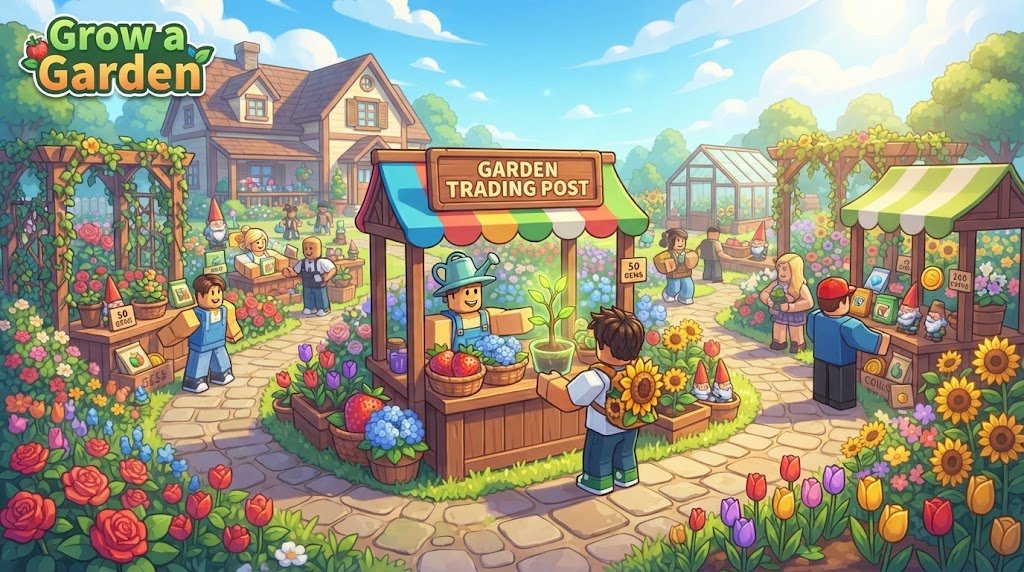
Grow a Garden Trading Guide 2026: Values, Tips & How to Trade
Complete Grow a Garden trading guide covering how to trade, pet values, the W/F/L system, scam prevention, and the best strategies to profit in 2026.
Grow a Garden Trading: Complete 2026 Guide to Values, Tips & Profit
Meta Title: Grow a Garden Trading Guide 2026 – Values, Tips & How to Trade
Meta Description: Master Grow a Garden trading with our full 2026 guide. Learn trade values, the W/F/L system, scam prevention, best pets to trade, and profit strategies.
On This Page
- What Is Grow a Garden Trading?
- How to Access the Trading Plaza
- How the Trade System Works Step by Step
- The W/F/L System Explained
- What Items Can You Trade?
- Grow a Garden Trading Values: Rarity Tiers
- Most Valuable Items for Grow a Garden Trading
- What Affects Grow a Garden Trading Values?
- Best Trading Strategies to Profit
- Grow a Garden Trading Scams to Avoid
- Common Trading Mistakes Beginners Make
- Trading Value Comparison Table
- FAQ: Grow a Garden Trading
What Is Grow a Garden Trading?
Grow a Garden trading is the in-game system that lets Roblox players exchange pets, harvested crops, Sheckles, eggs, and event-exclusive collectibles with other players. Whether you are trying to complete a collection, upgrade to a rarer pet, or flip items for profit, grow a garden trading is the heart of the game's economy.
The trading system is built around player demand rather than fixed shop prices. That means the value of any item in grow a garden trading shifts constantly based on what people want right now, how many of an item exist, and whether the game developers have recently buffed or nerfed certain content. Understanding this dynamic economy is the difference between consistently winning trades and consistently taking losses.
This guide covers everything you need to know about grow a garden trading in 2026 — from your first trade to advanced profit strategies used by the top players on the server.
How to Access the Trading Plaza
Before your first grow a garden trading session begins, you need to reach the Trading Plaza inside the game. Here is how:
- Launch Grow a Garden on Roblox.
- Look for the Trading Plaza portal in the main game world — it appears as a dedicated zone separate from your farm plot.
- Enter the plaza to access the trading zone where other live players are browsing, advertising, and exchanging items.
- Purchase a Trade Ticket from the Gear Shop if you want to initiate a trade yourself. The ticket cost varies — always check the current in-game price since it updates with patches.
The Trading Plaza is always populated with players broadcasting what they have and what they want. Reading these broadcasts before approaching anyone will save you time and give you a sense of current market demand in real time.
How the Trade System Works Step by Step
Grow a garden trading uses a protected two-sided interface. Both players must review and approve the deal before it finalizes. Here is the full process:
Step 1 — Agree on terms first.
Before initiating a formal trade, chat with the other player to confirm exactly what is being exchanged. Note the specific pet (including its age, weight, mutations, and traits), crop quantity and quality, or Sheckle amount. Vague agreements lead to disputes.
Step 2 — Equip your Trade Ticket and approach the other player.
Activate the ticket from your inventory, then walk up to the player you want to trade with and interact with them to open the trade window.
Step 3 — Place items into the trade window.
Both sides add their offers to the trade panel. Do not rush this step — double-check every item's stats before moving forward.
Step 4 — Review both sides carefully.
Look at exactly what each party is putting in. Check mutations, weight, quantity, and rarity. This is the most important step of grow a garden trading. Scammers rely on you skimping here.
Step 5 — Confirm and complete.
Both players click confirm. Once both sides approve, the trade executes instantly. The game will notify you when it is done — verify your inventory immediately to confirm everything arrived.
The W/F/L System Explained
The W/F/L system — Win, Fair, Loss — is the community-standard framework for evaluating whether a grow a garden trading deal is good, equal, or bad for you.
| Rating | Value Range | What It Means |
|---|---|---|
| W (Win) | You receive 115%+ of what you give | You profit from the deal |
| F (Fair) | 85%–115% range | Both sides get roughly equal value |
| L (Loss) | You receive below 85% | You lose value |
Community-maintained value lists assign numerical values to items so you can calculate your side of a trade versus the other side. If your total received value divided by your total given value falls in the Win bracket, the trade benefits you.
Important: The W/F/L system is not official — it is a community tool. Values in grow a garden trading can vary between different value lists. Always cross-reference at least two trusted sources before making a significant trade.
What Items Can You Trade?
Grow a Garden trading supports several item categories. Not everything in the game is tradeable, so knowing the list prevents wasted time:
Tradeable:
- Pets (including their mutations, age, and weight stats)
- Harvested crops (with quality and mutation data)
- Sheckles (in-game currency)
- Eggs (event and regular)
- Event-exclusive collectibles (seasonal items)
Not tradeable:
- Seeds (cannot be traded directly in most cases — verify current in-game tabs)
- Gear items (check in-game for the most current tradeable list)
- Account-bound rewards from certain quests
The list of tradeable items changes with game updates, so always check the in-game trade interface tabs to see what is available at any given time.
If you're comparing related numbers, our Grow a Garden Trade Calculator covers a similar calculation in more detail. For background reading, see Roblox.
Grow a Garden Trading Values: Rarity Tiers
Grow a garden trading values are organized around rarity tiers. Higher rarity generally means higher demand and more trade value, though mutations and event status can push lower-rarity items higher.
Common Tier
These are the most frequently available pets and crops. In grow a garden trading, common-tier items have minimal value on their own. They are mostly used as fillers or bulk in larger trades. Even with a decent mutation, a common pet rarely commands premium value unless the mutation itself is rare.
Uncommon Tier
Uncommon items begin to have meaningful grow a garden trading value, especially if they have a good mutation. Players often start here when building trading inventory.
Rare Tier
Rare pets and crops represent the middle of the grow a garden trading economy. These are sought after by players who cannot yet afford top-tier items but want something better than uncommon. Rare items with high-value mutations (like Voidtouched or Prismatic) can compete with or exceed some Legendary base values.
Legendary Tier
Legendary pets are serious grow a garden trading currency. Items like the Disco Bee or Queen Bee sit in this tier and command significant trade value. Players at this level typically know the market well and negotiate harder.
Mythic / Event Tier
The rarest items in grow a garden trading. Limited seasonal pets that can never be obtained again after their event ends consistently rise in value over time. Divine Eggs, Prismatic crop variants, and top-tier event exclusives live here. These are the items the highest-level traders hoard and use as anchors for massive trades.
Most Valuable Items for Grow a Garden Trading
The exact top values in grow a garden trading shift with every major update, but consistently high-value items across 2026 include:
Top Pets:
- Disco Bee — event-exclusive, permanently removed after its season, consistently W-tier
- Queen Bee — rare hatch, high demand for collection and functional builds
- Limited seasonal pets from holiday events — value typically doubles post-event
Top Crops:
- Prismatic crop variants — the mutation dramatically inflates baseline crop value
- Divine-quality harvests from high-rarity seeds during weather bonuses
Top Collectibles:
- Divine Eggs — combine rarity with utility (hatching potential)
- Event-exclusive cosmetics no longer obtainable through the shop
Mutations That Add the Most Value: Mutations are often the deciding factor in grow a garden trading. The same pet at base value versus with a Voidtouched or Prismatic mutation can be worth several times more. The top mutations that amplify trading value in 2026:
| Mutation | Approximate Value Multiplier |
|---|---|
| Voidtouched | Up to 135× base |
| Prismatic | 50–100× base |
| Golden | 20–50× base |
| Rainbow | 15–40× base |
| Shiny | 8–15× base |
| Common mutations | 1–3× base |
Note: Exact multipliers shift with updates — verify via current community value lists.
What Affects Grow a Garden Trading Values?
Grow a garden trading values are dynamic. Understanding what moves prices helps you trade at the right time:
Supply and Demand
The fundamental driver. If everyone suddenly wants Disco Bees and very few exist, the price climbs. If a new patch makes a formerly rare pet obtainable more easily, its value drops. Watch community channels for demand spikes.
Game Updates and Patches
Developer updates are the biggest single-event price movers in grow a garden trading. A new farm mechanic that benefits a specific pet can triple its value overnight. A nerf to an ability can crater a previously popular item. Check patch notes the moment they drop.
Event Availability
Event-exclusive items are only obtainable during their window. The moment an event ends, supply is permanently capped. This is why event pets almost always rise in value over the following weeks — no new ones can ever enter the market.
Mutation Stack and Stats
Within the same rarity tier, the specific mutations a pet carries determines its individual grow a garden trading value. A Legendary pet with a Voidtouched mutation is worth far more than the same Legendary at base. Age and weight also factor into some pets' values.
Market Timing
Grow a garden trading values peak and dip with the weekly update cycle. Prices often drop slightly right after an update when content is fresh and supply is high, then recover as players consume the content and supply tightens.
Best Trading Strategies to Profit
Buy Low During Events, Sell High After
When an event runs, supply peaks and prices dip slightly because everyone can obtain the items. Stock up on event pets toward the end of the event window when others are cashing out and accepting lower offers. After the event closes, supply is frozen and prices rise steadily.
Flip Mid-Tier Items
Instead of going straight for top-tier pieces, experienced grow a garden trading players build capital by repeatedly flipping mid-tier items — buying slightly under market value from impatient sellers and reselling at market rate. Volume compounds faster than holding one expensive piece.
Hold Appreciated Inventory
Top-tier event items that have already left the pool rarely drop in value long-term. If you own a Disco Bee, there is rarely a good reason to panic-sell at a dip. Hold through market corrections if your item is genuinely rare.
Watch Developer Announcements
Information is the most valuable asset in grow a garden trading. The moment a developer announces a buff to a mechanic or a new event, react faster than the market. Buy anything that benefits before prices catch up.
Build a Reputation
Reliable traders attract better counter-offers. If you are known for fair deals and never scamming, players with top inventory will approach you for major trades. Your reputation is a long-term asset.
Grow a Garden Trading Scams to Avoid
Scams are the biggest risk in grow a garden trading. These are the most common tactics to watch for:
Last-Second Swap
The most frequent scam: the other player replaces a promised item with a lesser one right as you are clicking confirm. Always re-read the final confirmation window, even if you reviewed the items seconds before.
Trust Trade / Give-First
Any player asking you to hand over your items first and "promise" to send theirs after is scamming you. The trade system exists precisely so no one has to trust the other party. Never deviate from the official interface.
Fake Discord Middlemen
Some scammers claim to have a trusted "middleman" on Discord to facilitate an outside trade. Outside-platform grow a garden trading cannot be enforced or reversed. Ignore these proposals entirely.
Fake Value Lists
Fabricated screenshots of value lists inflating the scammer's items or deflating yours. Always verify values yourself on multiple trusted community platforms, not screenshots sent by your trading partner.
Urgency Pressure
"I have three other offers — decide now." Urgency is a psychological lever. Real trades do not expire in seconds. Take your time, verify values, and walk away from anyone rushing you.
Common Trading Mistakes Beginners Make
Not Verifying Values Independently
Taking the other player's word on what something is worth is the fastest way to take consistent losses. Always check current community value lists before confirming.
Ignoring Mutation Details
Two pets of the same species with different mutations can differ enormously in grow a garden trading value. Always click into the pet's detail panel before agreeing to exchange it.
Panic Selling After Updates
Patches sometimes cause temporary panic selling. Players dump items at low prices right after a nerf that turns out to be minor. Evaluate the actual impact before selling at a market dip.
Trading Purely by Emotion
Grow a garden trading is an economy, not a friendship simulator. Trading at a loss to be polite, or refusing a fair trade because you don't like the player, costs you value. Separate emotion from economics.
Not Checking the Final Confirmation Window
The most expensive mistake and the most common. Always read the confirmation screen one more time before clicking accept.
Trading Value Comparison Table
The table below shows approximate relative value ranges for item categories in grow a garden trading as of mid-2026. These are community estimates — actual values fluctuate.
| Item Category | Base Value Range | With Top Mutation |
|---|---|---|
| Common Pet | Low | Low-Medium |
| Uncommon Pet | Low-Medium | Medium |
| Rare Pet | Medium | Medium-High |
| Legendary Pet | High | Very High |
| Event Exclusive Pet | Very High | Extreme |
| Common Crop | Minimal | Low |
| Prismatic Crop | High | Very High |
| Regular Egg | Low | N/A |
| Divine Egg | High | N/A |
| Sheckles (currency) | Fixed (by amount) | N/A |
Verify exact values on current community-maintained value lists before trading.
Try our free Trade Checker to run these numbers instantly instead of doing the math by hand.
Many readers using this tool also check out the Grow a Garden Pet Value List for a related use case. You can also reference Game8 for official guidance on this topic.
FAQ: Grow a Garden Trading
How do I start trading in Grow a Garden?
Enter the Trading Plaza in-game, purchase a Trade Ticket from the Gear Shop, and approach another player to open the trade interface. For a related calculation, see our DevEx Calculator.
What are the most valuable items for grow a garden trading?
Event-exclusive pets (especially those no longer obtainable) with high-value mutations like Voidtouched or Prismatic are consistently the most valuable. Check current community value lists for the live top tier.
Is the W/F/L system official?
No. The Win/Fair/Loss system is a community tool, not built or endorsed by the developers. Values can vary across different lists, so always cross-reference.
Can I get scammed in grow a garden trading?
Yes. Never trade outside the in-game interface, never give items first, and always read the final confirmation screen carefully before clicking accept.
Do grow a garden trading values change?
Yes, frequently. Values shift with game updates, event cycles, supply changes, and community demand. Check fresh value lists before every significant trade.
What mutation adds the most trading value?
Voidtouched and Prismatic mutations are consistently the top multipliers. A common or uncommon pet with Voidtouched can rival a base Rare pet in grow a garden trading value.
Can you trade seeds?
Seeds are generally not tradeable directly — verify current tradeable tabs inside the in-game trade interface since this changes with updates.
How long does a trade take?
The trade process itself takes under two minutes once both players are ready. The time is mostly spent on verification — which you should never rush. See Roblox Creator Docs for more authoritative detail.
How Trading Differs from Buying in the Shop
New players often confuse the shop system with player-to-player exchange. The in-game shops sell seeds, tools, and basic gear for Sheckles — fixed prices, no negotiation. The trading plaza is entirely different. Here, prices are set by what the community agrees something is worth, and that shifts constantly.
This means the same pet can be worth radically different amounts depending on when you are trying to trade it. A pet released two updates ago and still in high demand commands a premium. A pet released three updates ago that has been power-crept by newer options loses value week by week. Knowing which side of that curve any given item sits on is core to becoming a skilled trader.
Using a Trade Calculator Before You Confirm
One of the simplest ways to avoid a bad deal is to use a trade calculator before you confirm the exchange. A trade calculator lets you input the items being offered on both sides and calculates whether the deal lands as a Win, Fair, or Loss based on current community values. This removes guesswork and emotion from the equation.
Our Grow a Garden Trade Calculator is updated regularly to reflect current market values. Before any significant trade, especially one involving event-exclusive pets or top-tier mutations, run both sides through the calculator first. Thirty seconds of verification prevents hours of regret.
Building Your First Trading Inventory
Starting with nothing valuable is normal. Most high-level traders built their inventory from scratch. Here is a realistic path from beginner to mid-level trader:
Phase 1 — Farm for tradeable items.
Focus on farming crops with active weather buffs and mutations active. Prismatic or Voidtouched crops from a good farming session give you something worth trading with. You do not need a rare pet to start — quality crops are always in demand.
Phase 2 — Trade up gradually.
Use crops to acquire a low-tier pet with a decent mutation. Then use that pet to trade up to a mid-tier pet. Each step up takes longer, but this "ladder" approach is the most reliable path. Attempting to jump straight from common items to Legendary in one trade almost always results in a Loss.
Phase 3 — Target event items early.
As soon as a new event drops, prioritize earning the event-exclusive pets and collectibles. These appreciate after the event ends. Even if you do not want them long-term, holding them for two to four weeks post-event and then trading them for something you do want is a reliable value gain.
Phase 4 — Specialize.
Once you have built capital, identify what you enjoy trading most — pets, crops, or currency. Specialists who deeply understand one market segment consistently outperform generalists who spread thin across everything.
How Updates Change the Trading Market Instantly
Every major update to Grow a Garden reshapes the trading market. Here is how to react intelligently:
When a new pet is introduced, its value starts high (demand is fresh, supply is zero) and typically normalizes over two to three weeks as more players hatch or earn it. Early sellers at the peak get the best value; late sellers usually settle for less.
When a mechanic is buffed, any pet or item associated with that mechanic rises in value. React within hours if you own the beneficiary — or buy the beneficiary immediately if you spot the buff before prices catch up.
When a nerf hits, assess severity before selling. Minor nerfs often cause temporary panic that recovers within a week. Major nerfs that fundamentally change an item's usefulness require faster action.
When an event ends, hold the event items through the initial sell-off period. The first week after an event closes, many players dump their event items simultaneously, briefly depressing price. By week two to three, that supply dries up and prices begin the long-term climb.
Grow a garden trading rewards patience, market knowledge, and attention to detail. Whether you are flipping mid-tier pets for profit or holding rare event collectibles for long-term appreciation, the strategies above give you a genuine edge. Use our Grow a Garden Trade Calculator to verify your next trade before you confirm — and never click accept without checking the final window one last time.
Abdullah
Grow a Garden player & calculator builder